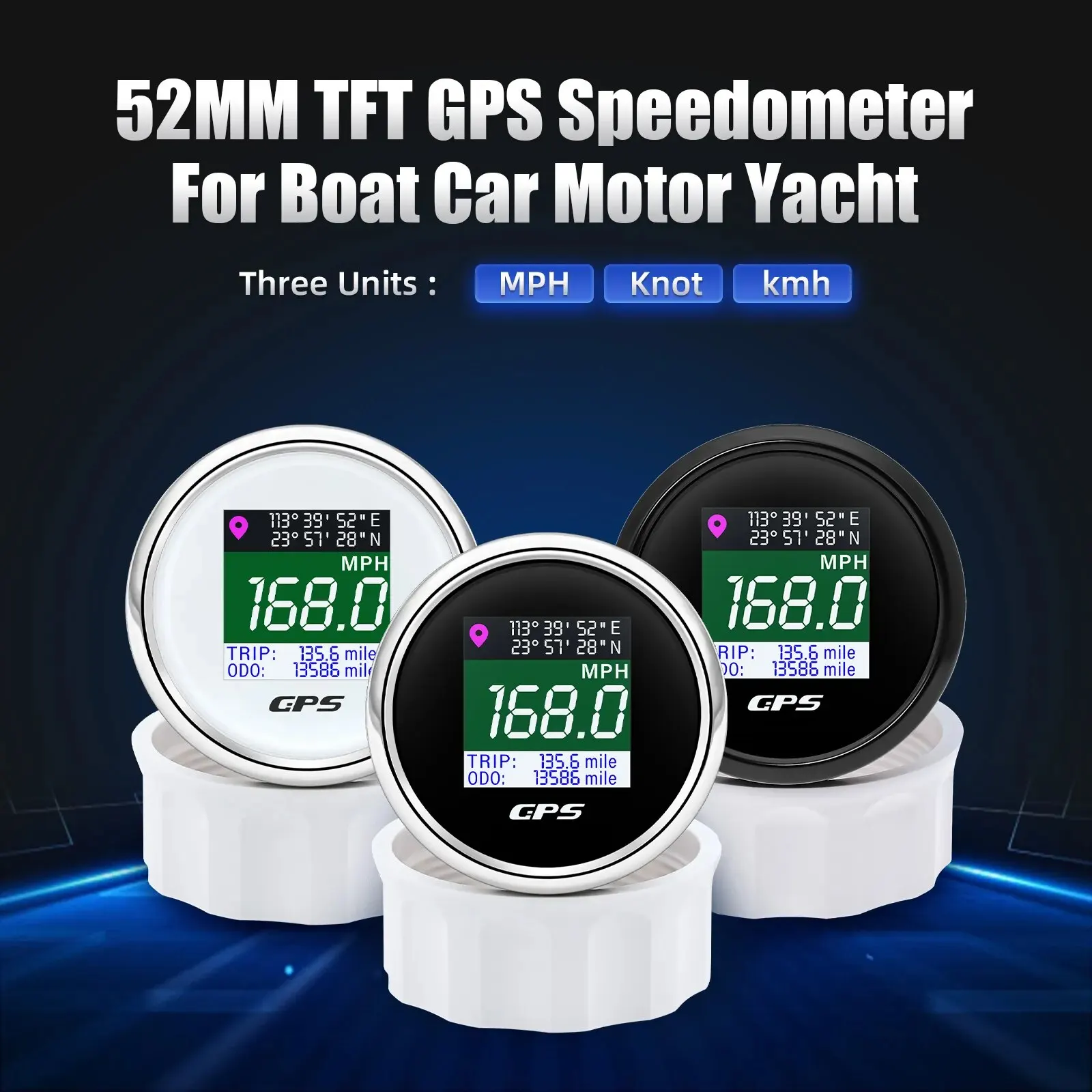
GPS Nautique/Auto : Compteur Vitesse 52mm Écran TFT - IMBATTABLE !
- Compteur vitesse bateau GPS 52mm écran TFT précis
- Installation facile compteur vitesse GPS voiture affichage numérique
- Meilleur compteur vitesse GPS 52mm marine avec écran TFT rétroéclairé
- Compteur vitesse GPS nautique étanche écran couleur TFT
- Compteur vitesse GPS automobile 52mm pour bateau, voiture et camping-car
- Comparer compteur vitesse GPS 52mm TFT : avantages et inconvénients
- Prix compteur vitesse GPS 52mm écran TFT abordable et fiable
- Compteur vitesse GPS 52mm écran TFT : calibration et réglages
- Achat compteur vitesse GPS 52mm écran TFT : où trouver ?
- Compteur vitesse GPS 52mm TFT compatible avec sondeur et traceur
- Compteur vitesse GPS 52mm écran TFT : navigation et sécurité
- Fonctionnement compteur vitesse GPS 52mm TFT : explication détaillée
- Compteur vitesse GPS 52mm TFT pour sports nautiques et automobiles
- Compteur vitesse GPS 52mm écran TFT : précision GPS, vitesse instantanée
- Avantages du compteur vitesse GPS 52mm TFT par rapport aux compteurs analogiques
- Compteur vitesse GPS 52mm TFT avec alarme de vitesse et capteur de direction
- Compteur vitesse GPS 52mm TFT : qualité d'affichage, résolution écran
- Compteur vitesse GPS 52mm écran TFT : installation et câblage simplifié
- Compteur vitesse GPS 52mm écran TFT : test et avis clients
- Compteur vitesse GPS 52mm écran TFT : comparaison avec autres modèles (VDO, KUS)
- Compteur vitesse GPS 52mm écran TFT : données NMEA, information de cap
- Compteur vitesse GPS 52mm écran TFT : écran anti-reflet
- Compteur vitesse GPS 52mm écran TFT : garantie et service après-vente
- Compteur vitesse GPS 52mm Écran TFT : étalonnage, calibrage, vitesse GPS, cap, direction, étanchéité, marine, automobile, bateau, voiture, camping-car, rétro-éclairage, numérique, affichage, installation, comparaison, avis, prix, calibration, réglages, sondeur, traceur, navigation, sécurité, données NMEA, instantanée, analogique, alarme, capteur, résolution, cablage, test, VDO, KUS, garantie, service après-vente.
**GPS Nautique/Auto : Compteur Vitesse 52mm Écran TFT - IMBATTABLE !**
Attrapez le signal parfait : L'antenne JABS-SL10 révolutionnaire !GPS Nautique/Auto : Compteur Vitesse 52mm Écran TFT - IMBATTABLE ! (Or Is It?)
Okay, buckle up buttercups, because we're about to dive headfirst into the wild, wonderful (and sometimes frustrating) world of the GPS Nautique/Auto Compteur Vitesse 52mm Écran TFT - IMBATTABLE ! – a mouthful, I grant you. But trust me, this little guy has the potential to revolutionize your boat/car life. Or at least make you feel a little less like a clueless landlubber (or, you know, bad driver). I've spent the last few weeks getting intimately acquainted with this gadget, and let me tell you, it's been a journey.
The Alluring Promise: Why I Fell for This Tiny Speed Demon
Right off the bat, the promise of "IMBATTABLE!" on the tinplate gets you, doesn't it? Who wouldn't want something they thought was unbeatable? For me, it was the siren song of accurate speed readings. I'm a sailor at heart, terrible at guessing the wind speed and even worse at estimating how fast I'm actually going. Also, I do a lot of driving, and my car's speedometer is… well, let's just say it has a personality of its own. Sometimes it agrees with the speed limit, sometimes it's actively trying to get me a ticket. Enter the GPS speedo! A beacon of hope in a sea of vaguely-accurate gauges. I was hooked. And I'm a sucker for the compact 52mm size; it fits perfectly on my boat's cluttered console.
The Buzzwords that Got Me: GPS, TFT Screen, and the Myth of "IMBATTABLE"
Come on, what's not to love? GPS! Technology! TFT Screen! Fancy! And then that glorious, self-assured proclamation: IMBATTABLE! Marketing genius right there. It played on my, admittedly naive, belief that technology is always better. And hey, a modern, bright screen is infinitely preferable to the old-school needle-and-dial setup. But the real question, the one I was ready to answer, was: was it actually unbeatable?
Unboxing and Initial Glee: "Ooh, Shiny!" and the Curse of the Instruction Manual
The unboxing was pure joy. Okay, maybe "joy" is a strong word. But the little box felt substantial, the unit itself looked sleek and… yeah, shiny! I unwrapped it like it was Christmas morning. The TFT screen was vibrant, even indoors. I could practically see the waves (or the asphalt, in the case of my car) calling to me.
The Dreaded Manual: A Dance of Frustration and Hope
Then came the inevitable - the instruction manual. Oh, the manual. It was a testament to the fact that even the most brilliant minds can struggle to communicate clearly. Filled with tiny, incomprehensible diagrams and what I think were translations from… well, I'm not entirely sure. Probably some far-off planet where "easy installation" means "prepare for a week of existential dread." I spent a good hour deciphering it, muttering curses under my breath, and feeling a growing sense of… well, you know, I'm just going to skip that part. But I persevered.
Installation: The Boat Edition - Where Patience Met Chaos
Installing this on my boat was a whole other ball game. Now, I'm not exactly handy. I can barely change a lightbulb without summoning the spirit of my inner electrician (who is, incidentally, about as knowledgeable as a toaster).
The Wiring Woes: Fishing for Wires and Feeling Like an Idiot
Routing the wires was a comedy of errors. My boat's wiring is a tangled mess (don't judge), and I spent a good portion of the day contorted in awkward positions, trying to snake the power cable through hidden compartments. Twice, I dropped a screw into the bilge. Twice! It was a true test of my patience, and my back. But the satisfaction when it all clicked into place and I got a reading? Priceless.
My First Fails: Testing on the Water and the Unexpected Obstacles
Finally, the moment of truth. I fired up the engine and… nothing. The screen stayed dark. Panic. More frantic manual-reading (yes, I'd finally found the section on troubleshooting). Turns out, I'd wired it backwards. Classic. Second try, and voila! The numbers sprang to life. Well, sometimes. On calm waters, it was spot on. But introduce a bit of chop, or try and hold my angle to the wind -- and the numbers started to dance. In my experience, there's no perfect in open water.
Installation: The Car Edition – A Slightly Less Dramatic Saga (But Still Messy)
Installing this in my car was, thankfully, less… nautical. But even here, things weren't perfect. I figured, "hey, I can run this in the car since that's where I spend more time".
The Cigarette Lighter Option: A Temporary Fix and a Case of Deja Vu
The cigarette lighter adapter was the easy path. I plugged it in, and BOOM, we had speed! But then I remembered, I have to disconnect it to park the car, and I always leave it running. So, it became more of a… well a decoration, really.
Wiring Under the Dashboard: Facing the Dark Side of Car's Interior
I finally started the car installation with a bit of courage. I figured I could run the wires underneath the dashboard neatly. I began by removing the dashboard, then the first few screws. I felt almost professional. And then, I noticed a random screw just resting on the side…
The Great GPS Signal Hunt: Finding the Elusive Satellites
Finding the GPS signal in my car was, well, lets just say it wasn't easy, and still isn't. I mean, the manual said, "position the antenna to an area with a clear view of the sky." Easy, right? Right? Turns out, the trees in my neighbor's yard really mess with my car's GPS signal. I had to take my car to random places, just to get a reliable reading. It was almost comical.
The Good, the Bad, and the Ugly: The Real-World Performance
After a few weeks with the GPS Nautique/Auto Compteur Vitesse, I've got a somewhat balanced view. It's good. It's bad. And it's definitely got its moments.
The Good: Speed Accuracy, Once It Actually Works! And the Cool Factor
When it does work, the speed accuracy is fantastic. I'm talking pinpoint accurate. Especially on calmer, wider bodies of water. The ability to compare my actual speed with my boat's chart plotter is a game changer – a constant source of smug satisfaction when I'm out on the water. And let's be honest, the TFT screen is cool. It looks sleek, modern, and makes me feel like I'm captaining the Starship Enterprise (in both my boat and car).
The Bad: The Signal Dropouts, the Occasional Glitches, and the Manual's Curse
But here's the truth: the signal can be… temperamental. Especially when you're surrounded by trees, bridges, or anything that vaguely resembles a roof. The screen froze on me once. I was driving, and it just stopped. I had to pull over and restart it. Also, as I've already mentioned: the manual is a menace.
The Ugly: The Moments of Doubt, the Frustration, and the "IMBATTABLE?" Question
There were times, I'll admit, when I questioned my sanity. When I swore at the sky, at the trees, at the car. Times when I thought, "Is this whole thing actually… IMBATTABLE?" (Spoiler alert: the answer is a resounding maybe). The biggest problem? The inconsistency. Sometimes it's perfect, sometimes it's useless. It's like having a demanding, moody companion, always on the edge of breaking up. I wasn't exactly alone with this. My neighbor's experience mirrored mine.
Overall Verdict: Would I Recommend It? (The Million-Dollar Question)
So, would I recommend the GPS Nautique/Auto Compteur Vitesse 52mm Écran TFT - IMBATTABLE ! ?
The Boat Guy’s Take: A Qualified "Yes" with a Side of Caveats
For my boat, yes, mostly. The accuracy when it works is fantastic, and it gives my boat’s old console a much-needed facelift. However, I'd recommend you be prepared for some signal dropouts, be really patient with the installation, and maybe learn a new language (that manual…). But I think for a serious boater, the benefits outweigh the drawbacks.
The Car Guy’s Take: A Less Enthusiastic "Maybe" and the Search for the Ideal
For my car, it’s a bit more tricky. The cigarette lighter is a mess. The wiring is a huge commitment. The signal is a bit flakey. In the end, I feel it's not quite as polished as it needs to be.
The Final Word: Flawed, But Still Pretty Damn Cool
Ultimately, the **GPS Nautique

FAQ sur le Compteur de Vitesse GPS Nautique/Auto 52mm avec Écran TFT - IMBATTABLE ! (et ses petites manies)
Salut les marins/conducteurs du dimanche ! Bon, soyons honnêtes, ce bidule GPS/TFT, on en attendait beaucoup. Et... bah, voyons. On y va avec les questions que vous *voulez* poser (ou que vous devriez vous poser, sérieusement).
1. Est-ce que c'est vraiment "imbattable" comme il est dit ? Et franchement, c'est quoi le TFT ?
"Imbattable"... disons que c'est du marketeux pur jus. En vrai, pour le prix, la qualité est *très* bonne. Le GPS accroche vite, c'est clair. Et le TFT... c'est l'écran couleur. C'est pas du OLED du dernier cri, mais c'est lisible, même en plein soleil. J'ai un pote qui l'a installé sur son canot (oui, il a un canot, le chanceux) et il était *fou* de joie, il voyait ENFIN sa vitesse sans galérer avec son vieux loch. C'est *nettement* mieux que ces vieux compteurs à aiguille qui bougent au gré des humeurs de Neptune.
Anecdote : J'ai monté le mien sur ma bagnole, une vieille clio qui a plus de bornes que Bernard Tapie. Il a fallu bricoler sévère pour l'intégrer correctement (merci YouTube !). La première fois que je l'ai allumé, j'ai cru que j'étais en train de décoller pour Mars tellement il affichait vite ma vitesse ! (J'ai vite réalisé que c'était un bug, mais quand même, ça m'a fait marrer.)
2. C'est facile à installer ? Parce que moi et l'électricité...
"Facile" dépend de votre niveau de bricolage. Si vous savez brancher une ampoule, vous devriez vous en sortir. Il y a trois fils : plus, moins et le signal de contact (pour allumer le compteur quand vous mettez le contact). Si vous avez peur, faites appel à un pote ou un mécano. Mais honnêtement, avec un peu de patience et un multimètre, ça se fait.
Petite galère : J'ai eu un petit problème avec les fils. Ils étaient un peu fins, et j'ai mis du temps avant de trouver le bon endroit pour les connecter. J'ai grillé deux fusibles avant de comprendre que je devais souder les fils plutôt que de les coincer avec du scotch (honte à moi !).
3. Il y a quoi comme infos affichées ? C'est complet ?
C'est *pas mal* complet, oui ! Vitesse (évidemment), cap, distance parcourue, heure... bref, le minimum syndical. Il y a même une alarme de vitesse, c'est pratique pour éviter les PV (si vous êtes du genre à appuyer sur le champignon, comme moi... hum hum).
Ressenti personnel : J'aurais bien aimé un petit indicateur de consommation de carburant, mais bon, on ne peut pas tout avoir ! Ah, et le cap... parfois il hésite, surtout quand on est entouré de bâtiments. C'est un peu énervant, mais c'est le GPS, quoi.
4. Il prend l'eau ? Parce que sur un bateau... ça craint.
Il est *censé* être étanche, oui. J'ai pas fait de plongée avec (et je ne vous le conseille pas !). Mon pote avec son canot n'a pas eu de soucis, même sous la pluie et les embruns. Mais bon, on n'est jamais à l'abri d'une fuite, hein...
Expérience critique sur l'étanchéité : Mon pote a vraiment *souffert*. Pendant une sortie, un méchant coup de vent, une vague *énorme* est passée sur son canot. Le compteur a pris l'eau. Il a arrêté de fonctionner, et il a fallu séchage et le remettre en marche. Il a eu un peu peur, mais finalement, il a survécu. Son avis : "C'est pas un sous-marin, mais ça tient le coup."
5. La lisibilité, vraiment ? Même avec le soleil ?
Oui, la lisibilité est *bonne*. Le TFT, on en a déjà parlé, est clairement un plus. C'est pas le top du top, mais comparé à un compteur d'origine de ma vieille bagnole... c'est le jour et la nuit! J'ai réussi à lire la vitesse même avec le soleil en pleine face. L'écran est contrasté, les chiffres sont grands. Il est possible que vous ayez à ajuster l'inclinaison de l'écran selon l'angle du soleil, mais rien de bien méchant.
Point faible : J'avoue, les reflets, parfois... Selon l'angle, on peut avoir quelques reflets. On s'y fait assez vite, mais c'est pas parfait. Surtout quand on a le soleil dans le dos, on a parfois du mal à distinguer les chiffres.
6. Et le prix ? C'est abordable ? (Parce que le budget...)
Oui, le prix est *vraiment* raisonnable. Moins cher que le compteur d'origine de ma bagnole, et bien plus performant ! C'est un excellent rapport qualité/prix, clairement. On ne va pas se ruiner pour ça.
Bilan financier : Honnêtement, vu le prix, on peut dire que c'est une excellente affaire. Si vous hésitez à plus dépenser pour un modèle plus cher, je vous conseille de commencer par celui-ci, vous ne serez pas déçus.
7. Des problèmes particuliers ? Des trucs qui énervent ?
Bon, soyons francs, il y a quelques petits trucs. * Le démarrage parfois... Il met un peu de temps à accrocher le GPS, surtout au fin fond de la forêt. * Les réglages... Il faut se pencher dessus pour les régler. * Le manuel... Un peu "chinois", mais on finit par s'en sortir (YouTube est votre ami !).
Le point noir : J'ai eu un problème avec le bouton de configuration. Il est fragile. Si vous le


